As Jesus walks toward Jerusalem, a massive crowd surges behind Him like rolling clouds. Their eyes glitter with expectation. They have seen the "superstar" who heals the sick, multiplies bread, and performs miracles-and they assume that when He enters Jerusalem, a brand-new kingdom will dawn, and some crumbs of glory will surely fall to them as well. The air fills with worldly anticipation, thick as rising dust.
Then, the Jesus who had been leading suddenly stops. He turns around, faces the crowd, and delivers a chilling, shocking word-like cold water thrown over their feverish excitement:
"If anyone comes to Me and does not hate his own father and mother and wife and children and brothers and sisters-yes, and even his own life-he cannot be My disciple."
The scene of cheering mouths falling silent confronts us with the same discomfort today.
A Moment When the Order of Love Is Rearranged
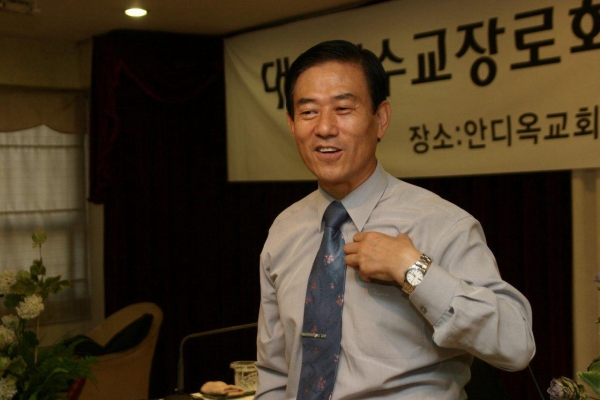
We often assume that if we believe in Jesus, peace will settle into our homes and everything will go smoothly. Yet, through this difficult passage, Pastor David Jang (Olivet University) presses the most foundational question of faith into our hearts.
The "hate" Jesus speaks of is not emotional hostility. It is a radical reordering of priorities. Human nature tends to treat what is visible-family bonds, one's own life, and possessions-as absolute values. But when the light of the gospel enters, the pyramid of values we thought unshakable must be turned upside down.
Pastor David Jang explains this with a clear and disarming illustration. Imagine a mother holding an ice cream. If she offers the first bite not to her little daughter but to her elderly mother, the child may cry, "Mom doesn't love me!" Yet it is not a lack of love-it is the difference in the order and depth of love.
To love God more than father and mother, more than spouse and children, even more than one's own life-this is not the abolition of love for others. Rather, it is the restoration of a holy order: by placing the Creator at the highest place, every other love finally finds its rightful position and flows properly. Without this exclusive devotion, we can never become true disciples.
Caravaggio's The Calling of Saint Matthew and the Decision of the Moment
At this point, one is reminded of the masterpiece The Calling of Saint Matthew by the Baroque genius Caravaggio. In a dark tax booth, Levi (Matthew) counts coins with greedy intensity. Then, from the right side of the canvas, Jesus enters with a powerful beam of light and points at him.
Jesus' gesture resembles the hand in Michelangelo's The Creation of Adam-the hand that awakens. Yet the climax of the painting is Matthew's face: the tension of an instant. His expression seems to ask, "Me?"-and in that astonished hesitation lies the question of whether he will let go of the money he is clutching.
In today's passage, Jesus speaks of a man building a tower and a king going to war. He warns against beginning without calculating the cost-laying only a foundation and becoming an object of ridicule. Pastor David Jang emphasizes here that discipleship is not an emotional "hobby club," nor a short-lived burst of enthusiasm.
Just as Matthew in Caravaggio's painting had to push back from the money table and rise, the path of a disciple requires a thorough cost calculation. And that cost is the "cross"-one's own cross. A faith that wants only glory while refusing suffering and self-denial is nothing more than an unfinished tower-an eyesore of spiritual half-building.
Cutting the Anchor of Possessions and Becoming a Free Wind
Modern people live trapped in what Erich Fromm called the "having mode." We seek meaning in accumulating more and stacking higher. But through Jesus' words-"give up all that you have"-Pastor David Jang urges a decisive turn toward the "being mode."
Just as someone who has crossed a river no longer needs to carry the boat on their head, those who have crossed the river of grace no longer need to cling to worldly possessions as objects of obsession.
In the sermon, the phrase "a refreshing wind" is especially striking. The Lord who said, "Foxes have holes and birds have nests, but the Son of Man has nowhere to lay His head," lived a life of "no possessions." Yet His was not a life of mere poverty-it was the freedom of the Spirit, unbound and unowned.
When salt loses its taste, it is thrown out and trampled underfoot. In the same way, when believers compromise with materialism and lose their "saltiness," the world mocks the church. As Pastor David Jang's insight makes plain: only when we cut the anchor of possession can we become that cool, holy wind the world cannot contain-awakening our age.
Epilogue: Toward an Upgraded Faith
Even now, the Lord turns to us and asks:
"Are you part of the crowd-or are you a disciple?"
If we have remained at the level of the "crowd," merely stepping into the churchyard to be comforted, then it is time to be upgraded into disciples who carry the cross and follow the Lord.
The three conditions of discipleship Pastor David Jang proclaims-reestablishing priorities, enduring the cross, and freedom from possessions-lead us onto a narrow and constricted path. Yet at the end of that path is life, and the glory of resurrection awaits.
Those who have ears to hear must hear. Having finished the calculation, taking hold of the plow and not looking back-advancing without retreat toward that rugged hill of the cross-this is what "salt that has not lost its taste" should look like in our time.